Korean Noodles Explained: Every Major Type and Dish
Korean noodle cuisine spans six canonical types plus instant ramyun. This guide covers each noodle, its dishes, cooking rules, and where to buy every variety in the UK.
Six Types, One Ramyun Category
Korean noodle cuisine is built on six canonical noodle types, each defined by its starch source. The starch determines the texture, how the noodle behaves in heat, which dishes it belongs in, and what happens if you substitute one type for another. Getting this wrong is the most common source of failed Korean noodle dishes.
There is also a seventh category that is technically not traditional: instant ramyun. It deserves its own section because it is the most widely consumed form of Korean noodles in the UK and in Korea alike.
The Six Canonical Types
Dangmyeon -- Sweet Potato Glass Noodles
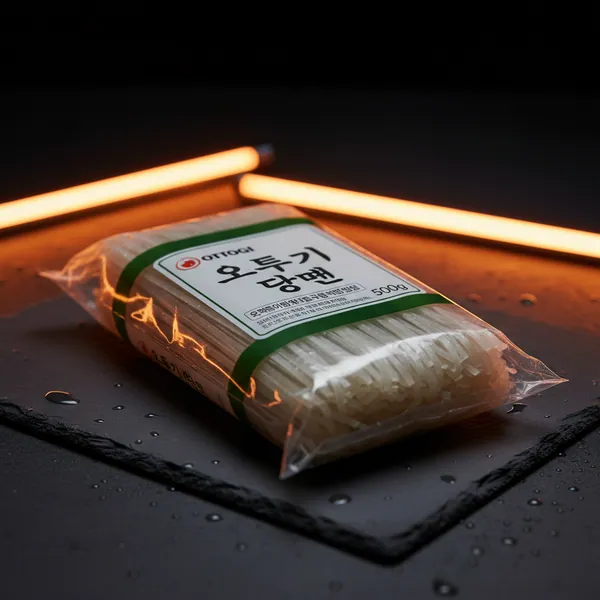
Dangmyeon (당면) is made from sweet potato starch. When dry it looks like thin white wire; when cooked it turns translucent and takes on a springy, glass-like chew that holds up under heat without going mushy. This is the only Korean noodle that genuinely does not get worse with sitting -- cooked dangmyeon dressed with sauce can sit for an hour before serving and it will still be good.
The primary dish is japchae: dangmyeon stir-fried with soy sauce, sesame oil, sugar, thinly sliced beef, spinach, carrot, onion, and mushrooms. Japchae is a celebratory dish -- standard at Korean weddings, birthdays, and Chuseok (Korean Thanksgiving). It is served warm or at room temperature, and left-over japchae eaten cold from the fridge the next day is arguably better than freshly made.
Dangmyeon also appears as a garnish in sundubu-jjigae (soft tofu stew) and in some one-pot stews where it absorbs broth flavour. Its 18-month dried shelf life makes it one of the most useful pantry items in Korean cooking.
**UK sourcing:** Ottogi dangmyeon is available from Amazon and Sous Chef. All oriental supermarkets stock it, including Wing Yip. It is not yet at mainstream UK supermarkets.
Guksu and Kalguksu -- Wheat Noodles
Guksu (국수) is the general Korean term for wheat noodles; kalguksu (칼국수) is the specific hand-cut variant, the name combining *kal* (knife) and *guksu* (noodles). Kalguksu is thicker, chewier, and slightly irregular in cross-section because it is cut by hand rather than extruded. It absorbs broth over time and softens from the outside in.
Kalguksu soup is the dish. The broth is typically anchovy-kelp or chicken, kept deliberately plain to let the noodle texture be the main event. Janchi-guksu (banquet noodles) uses thin wheat noodles in a refined anchovy broth -- the dish served at traditional celebrations where someone's luck needed acknowledging.
In the UK, fresh kalguksu is available refrigerated at New Malden Korean supermarkets with a shelf life of a few days. Dried versions are at all oriental supermarkets. Japanese udon is a workable substitute: same starch, similar texture, slightly different flavour.
Jajangmyeon Noodles -- Thick Alkaline Wheat Noodles
The noodles used in jajangmyeon (짜장면) are thick wheat noodles with a slight alkaline quality that makes them more elastic and better at holding a heavy sauce. They are specifically engineered for the job: when the black bean sauce (made from *chunjang*) is ladled on top, the noodles resist turning soggy in the way a thinner noodle would.
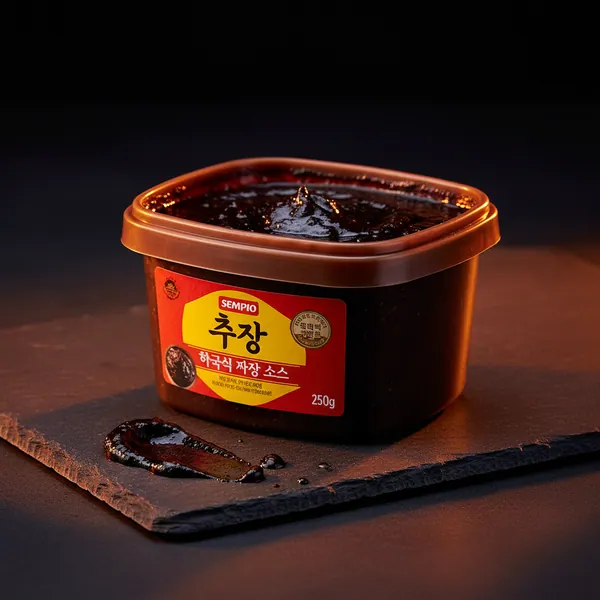
Chunjang -- fermented black soybean paste -- is the defining ingredient of jajangmyeon. It must be fried in oil before use. Raw chunjang is aggressively bitter; two to three minutes in hot neutral oil mellows it into the sweet, glossy, dark sauce that defines the dish. This step is not optional.
Jajangmyeon is Korean-Chinese cuisine, not Chinese food. Chinese immigrants in Incheon's Chinatown created it in the early 20th century and the Korean adaptation -- sweeter, more caramelised -- diverged sharply from the Shandong original. In Korea it has become a national comfort food, the standard order when moving house.
The same thick noodles are used in jjamppong (spicy seafood noodle soup), the red-broth counterpart to jajangmyeon's black sauce.
**UK sourcing:** Sempio chunjang is available from Amazon, Sous Chef, and Oriental Mart in 250 g tubs. Specifically look for "chunjang" rather than generic "black bean sauce" -- the latter is usually a Chinese product with a different flavour profile. Fresh jajangmyeon noodles at New Malden; dried bundles at oriental supermarkets.
Naengmyeon Noodles -- Buckwheat Cold Noodles
Naengmyeon (냉면) noodles are made from buckwheat blended with sweet-potato starch and sometimes kudzu, depending on the regional style. The result is thin, springy, and so chewy that scissors are served alongside the dish at the table to cut them into manageable lengths -- the noodles are too long and too resilient for chopsticks alone.
There are two canonical styles. Mul-naengmyeon (물냉면, "water naengmyeon") is buckwheat noodles in a clear, chilled beef broth garnished with sliced brisket, julienned cucumber, quartered Asian pear, and a boiled egg half. The broth is cold or near-frozen and the dish is consumed in summer as a cooling food, though in Korean BBQ restaurants it appears year-round as a palate-cleanser between meat courses. Bibim-naengmyeon (비빔냉면, "mixed naengmyeon") uses sweet-potato-starch noodles without broth, tossed in a spicy gochujang sauce.
The dish originated in North Korea. Pyongyang naengmyeon and Hamhung naengmyeon are named after cities in what is now the DPRK, and after the Korean War both styles migrated south with refugees. Both are now mainstream across South Korea.
**UK sourcing:** Ottogi or Pulmuone dried naengmyeon packs are available from Sous Chef, Amazon, and New Malden Korean supermarkets. Fresh naengmyeon at New Malden has a seven-day refrigerated shelf life.
Somyeon -- Very Thin Wheat Noodles
Somyeon (소면) is a very thin, round wheat noodle that cooks in two to three minutes. The equivalent of Japanese somen, which is interchangeable for all practical purposes. The texture is delicate compared to kalguksu.
Somyeon is used in bibim-guksu (spicy cold noodles with gochujang sauce and vegetables) and janchi-guksu (the refined anchovy-broth celebration noodle). It also appears as a garnish in some stews and hotpots.
**UK sourcing:** Japan Centre, Amazon, and any oriental supermarket. Japanese somen packs (Nisshin or similar) are the same product and widely available at Tesco and Sainsbury's.
Jjolmyeon -- Extruded Chewy Wheat Noodles
Jjolmyeon (쫄면) is made from wheat and cornstarch, extruded under high pressure to create an extreme chew -- *jjol* translates roughly as "springy to the tooth". It is noticeably more resistant to the bite than any other noodle type in Korean cuisine.
The primary dish is jjolmyeon: spicy cold noodles with gochujang sauce, cucumber, carrots, boiled egg, and vinegar. It is a street-food staple in Korea. Some tteokbokki variants incorporate jjolmyeon alongside the rice cakes.
**UK sourcing:** Rare in the UK. Sous Chef and specialist Asian grocers stock it intermittently; Amazon availability is inconsistent. If you cannot find it, thick udon with 30 seconds less cooking time approaches the texture.
Instant Noodles: Ramyun
Ramyun (라면) is not a traditional noodle type -- it is a category of pre-fried, shelf-stable wheat noodles sold with flavour sachets. In terms of volume consumed, it dominates Korean noodle eating in both Korea and the Korean diaspora. Understanding the main brands is practically useful.
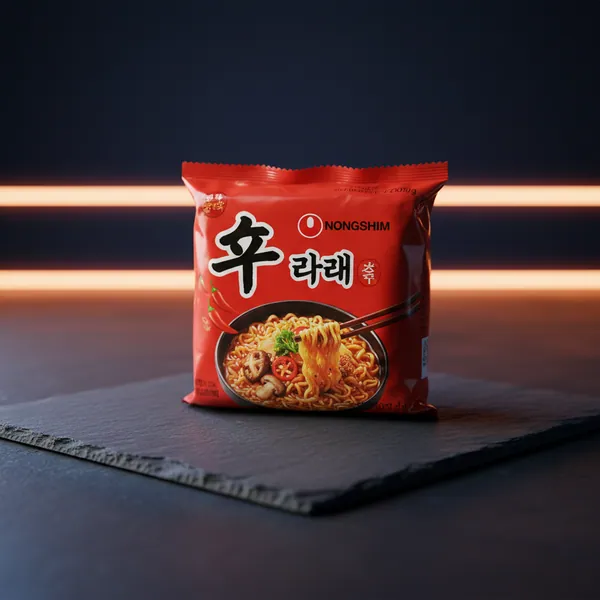
**Shin Ramyun (Nongshim)** is the default. Spicy beef broth, around 1,800 Scoville equivalent. The red packet is the one. Cook in boiling water for 4 minutes, add the powder and flake sachets, eat immediately. Available at Tesco, Sainsbury's, and any oriental supermarket in the UK.
**Jin Ramen (Ottogi)** comes in Mild and Spicy variants. Less harsh than Shin, with a rounder broth. Good entry point for people who find Shin too intense.
**Buldak (Samyang)** is the "fire chicken" noodle, the one responsible for multiple social media challenge formats. It is a sauce-type noodle, not a soup: drain the water, add the sauce packets, mix. The heat is genuine and substantial. Sub-variants include Carbonara (cream sauce), Cheese, and 2x Spicy (meaningfully hotter).
**Chapagetti (Nongshim)** is instant jajangmyeon. Not a soup; a black-bean sauce noodle drained and coated. The quickest route to jajangmyeon flavour without making chunjang from scratch.
**Neoguri (Nongshim)** is seafood-udon style: thick noodles in a spicy seafood broth. Milder than Shin.
**Chapaguri** is a combination dish: Chapagetti (jajang noodles) plus Neoguri (seafood broth). The dish gained international attention after appearing in the film Parasite (2019), where it is made with prime ribeye steak. The noodles are cooked together, the Chapagetti sauce sachet replaces the Neoguri broth powder, and the result is a black-bean sauce with seafood complexity. It works.
All six of these are available from Amazon UK and from any oriental supermarket. Tesco and Sainsbury's stock at minimum Shin Ramyun and sometimes Buldak.
Noodle Dish Quick Reference
| Dish | Noodle type | Broth or sauce | Served | |---|---|---|---| | Japchae | Dangmyeon | Soy and sesame | Warm or cold | | Jajangmyeon | Thick wheat | Chunjang and pork | Hot | | Jjamppong | Thick wheat | Spicy seafood broth | Hot | | Kalguksu | Hand-cut wheat | Anchovy or chicken broth | Hot | | Naengmyeon (mul) | Buckwheat blend | Chilled beef broth | Cold | | Naengmyeon (bibim) | Sweet potato starch | Gochujang sauce | Cold | | Janchi-guksu | Somyeon | Anchovy broth | Hot | | Bibim-guksu | Somyeon | Gochujang and vinegar | Cold | | Jjolmyeon | Jjolmyeon | Gochujang and vegetables | Cold |
Cooking Fundamentals
Four rules cover the most common mistakes in Korean noodle cooking.
**Do not rinse noodles in cold water unless the dish is served cold.** Rinsing removes the surface starch that allows sauce to cling. For naengmyeon and bibim-guksu this rinse is mandatory and the point of it; for japchae, kalguksu, or jajangmyeon noodles, rinsing is a mistake. The surface starch is what makes the sauce coat rather than pool.
**Salt the water for wheat noodles.** One tablespoon of salt per litre. This is the same principle as pasta: undersalted water produces bland noodles. Glass noodles (dangmyeon) do not need salted water.
**Undercook by 30 seconds when finishing in hot broth or sauce.** The noodle continues cooking in the liquid for the first minute after you add it. If you cook to package time and then add to a simmering broth, the noodle will be overdone by the time it reaches the table.
**Toss with a teaspoon of sesame oil if not serving immediately.** This prevents sticking without significantly altering the surface texture. It works for glass noodles, wheat noodles, and somyeon equally. Plain water rinse is inferior: it reduces sticking but also dilutes the noodle surface.
UK Sourcing Summary
**Tier 1 (Tesco, Sainsbury's, Amazon):** Shin Ramyun and Buldak ramyun are at major UK supermarkets. Somyeon (as Japanese somen) at Tesco and Sainsbury's. Ottogi dangmyeon on Amazon.
**Tier 2 (Wing Yip, Oriental Mart, New Malden):** Fresh kalguksu, fresh jajangmyeon noodles, fresh naengmyeon, and a full range of dried noodle varieties. Sempio chunjang at Oriental Mart. Naengmyeon dried packs year-round.
**Tier 3 (Sous Chef online):** Naengmyeon packs, dangmyeon, kalguksu, and specialist dried varieties. Good for mail order outside London. Sous Chef stocks Ottogi and Pulmuone brands reliably.